07 / CASE STUDY
LIVE DEMO
ZeroDown.
From a QR on the machineto a closed work order.
A maintenance system (CMMS) for factories, with no sensors or IoT. Operators report, supervisors triage and assign, technicians repair, and the asset history writes itself.
BUILT WITH
- Next.js
- TypeScript
- Prisma
- PostgreSQL
- Recharts
Every machine that stops leaves a trail, from the first report until the work is verified.
01 / CONTEXT
Factory maintenancestill runs on group chats.
A machine breaks, someone tells someone, and the work order gets lost along the way. Nobody knows how long the machine was really down. ZeroDown puts the whole flow in one place, and every reading is entered by a person.
02 / SYSTEM
Three roles,one flow.
The operator answers three questions: is the machine stopped, is there a safety risk, is product quality affected. Severity is computed from those answers, and priority comes from severity crossed with how critical the asset is.
- 01SCAN QR
- 02REPORT
- 03TRIAGE
- 04REPAIR
- 05VERIFY
CLOSED
03 / ENGINE
The rules livein the code.
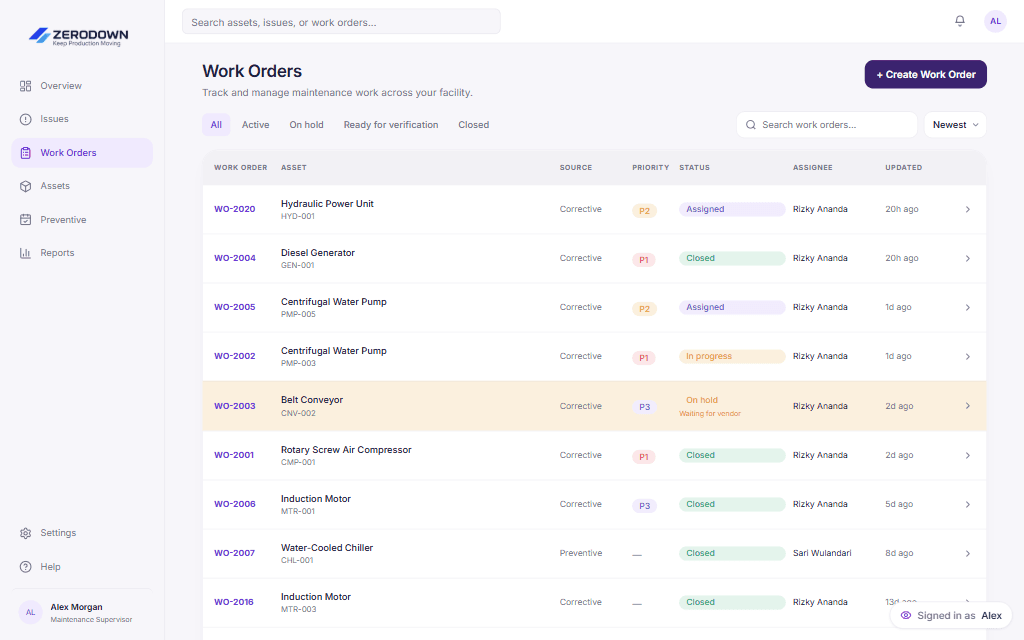
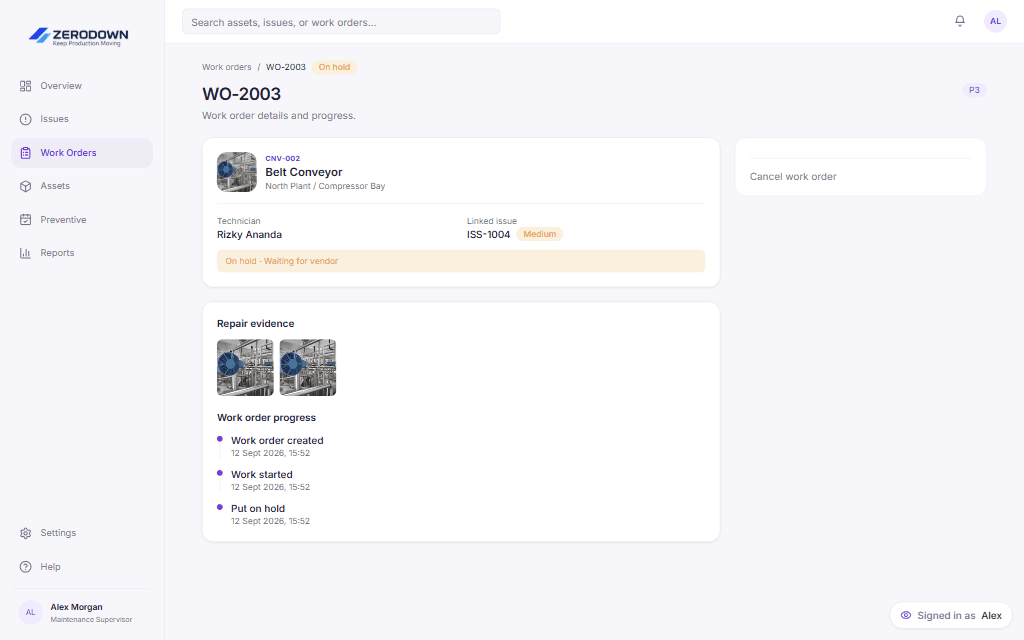
Issues and work orders are separate entities. Several reports can point to one work order, and preventive work orders have no report at all. Both move through a state machine: a technician can only reach "ready for verification", on hold always needs a reason, and verification can reopen the job.
04 / STATUS
Live, witha made-up factory.
ZeroDown is a portfolio project. The factory, its 36 assets, and its people are seeded, and there are no real users yet. Login is still a demo user switcher, and photo upload exists only in the interface. Try it yourself: pick a person from "Signed in as" in the bottom right.
DECISIONS
Why it is builtthis way.
- 01Three questions for the operator
Is the machine stopped, is there a safety risk, is quality affected. Severity comes from those answers, then crosses with asset criticality to set priority.
- 02Issues and work orders are separate
Several reports can point to one work order, and preventive work orders have no report at all.
- 03A state machine
A technician can only reach ready for verification, on hold always needs a reason, and verification can reopen the job.
- 04One event log
Work order timelines and reports read from the same source.
PRODUCT FLOW DEMO
SCREENSHOTS
Taken straight from the application while running.
NEXT PROJECT
Artha08 ↗